What to do when everyone says it and nobody hears it.
AI-powered. AI-driven. AI-native. Agentic. Intelligent.
Pulling your hair out as a marketer?
Somewhere in a marketing meeting this week, someone is adding “AI” to a headline that was perfectly fine without it.
We understand why. For many tech companies, AI is genuinely where the product is heading, the board wants to hear about it and every competitor is shouting it. Staying quiet feels like falling behind.
But when every message leads with the same word, that word stops carrying information. “AI-powered” has become what “cloud-based” was a decade ago: true, expected and – if we’re being totally honest with ourselves – almost entirely useless at telling one company apart from another.
The word is working against you
It’s not just that AI messaging is crowded. There’s growing evidence it can actively put people off.
In a Washington State University study, participants saw identical product descriptions, one mentioning artificial intelligence and one not. Across eight product and service categories, the AI version consistently lowered purchase intent because it reduced emotional trust. The effect was strongest for expensive, higher-risk purchases, which describes most enterprise technology.
More recently, a WordPress VIP survey in 2026 found 60% of US consumers see AI in brand messaging as a turnoff, and 61% couldn’t name a single brand using AI well in its messaging. Its CTO, Brian Alvey, described a telling pattern: when brands removed the word “AI” but kept the feature, it stopped being a turnoff and they sold more of their mid and upper-tier packages.
These studies are about consumers, and B2B buyers are more technical. But they’re the same humans, and the emotional mechanism holds. A buyer staking their reputation on a six-figure decision doesn’t want to feel uncertain. Vague AI claims make them feel exactly that.

Five ways to be heard above it all
1. Run the delete test
Take your headline and remove the word “AI”. If what’s left says something a buyer cares about, you have a message. If it collapses into nothing, you have a label.
AI is how your product works. It is rarely why someone buys it. Lead with what changes for the customer, and let the technology become the proof behind the promise.
2. Swap adjectives for specifics
“Intelligent”, “seamless” and “next-generation” can be pasted onto any product. Specifics can’t.
Compare “AI-powered threat detection” with “flags the fake invoice request before it reaches payroll”. The second is longer, but it’s the only one a buyer can picture. And a competitor can’t claim it without actually doing it. Brevity is often best but only when it’s coupled with clarity, and sadly the former is favored over storytelling that makes real human sense.
3. Speak to the feeling under the buzzword
Behind most AI buying decisions sit some very human worries. Am I falling behind? What if I back the wrong thing and it’s my name on it? What does this mean for my team?
Most AI messaging answers those worries with more hyperbole, which makes them worse. The brands that stand out lower the temperature. They say plainly what the product does, where people stay in control and, crucially, what it doesn’t do. Being honest about limits is rare enough to be a differentiator in itself.
4. Have a point of view, not just a capability
Capabilities get matched, often within a quarter. Beliefs are much harder to copy.
What do you believe about how AI should work in your category that a competitor would disagree with? Perhaps it’s that AI should never make the final call on something that matters. Perhaps it’s that the best automation is the kind nobody notices. A clear stance gives people something to agree with, and that’s the start of preference.
5. Write for the person who has to sell it internally
Your real audience is often the champion who has to explain your product to their CFO, their security team and their sceptical boss. In the 2025 Edelman-LinkedIn research, more than 40% of B2B deals stalled because of misalignment inside the buying group.
Give that person one clear sentence they can repeat without sounding like a brochure. If they can explain it in the lift (coupled with clarity, remember), you’ve done your job.
On the show floor
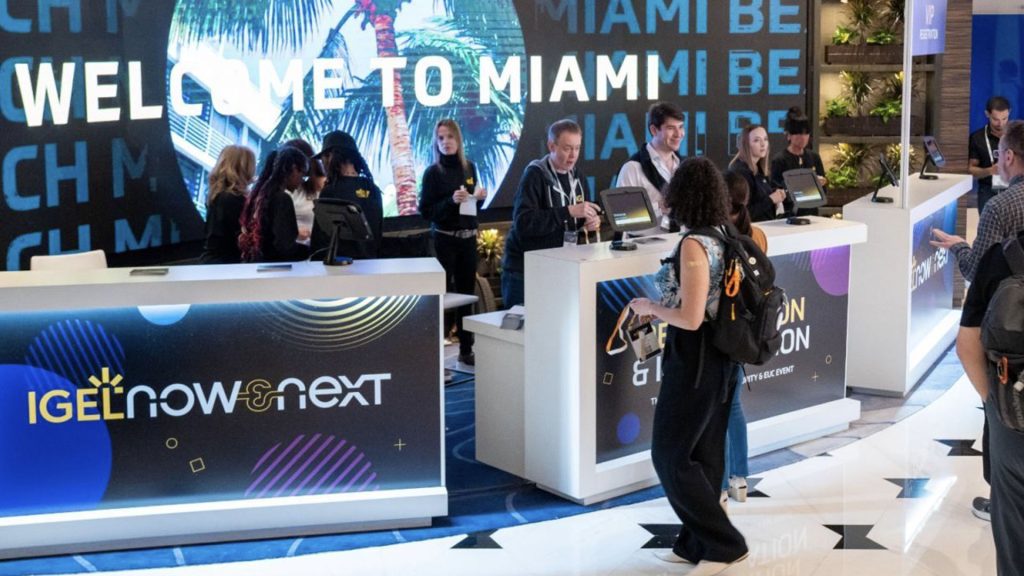
Events are where the AI noise is loudest, and where cutting through it pays off fastest. At a major tech show, you have a few seconds of someone’s attention as they walk past.
- Use the booth-opposite test
If your headline would work just as well on the stand ‘across the aisle’, rewrite it until it wouldn’t. - Show a task, not a swirl
Glowing neural networks and particle animations all blur together. A live demo of a real job getting done, before and after, sticks much better. - Let a customer say it
One customer explaining what changed for their team is worth more than any number of claims about intelligence. - Tell one story in the keynote
Pick a single problem and follow it through, rather than a montage of every AI feature on the roadmap. - Give your booth team one shared sentence
When every person on the stand explains the product the same clear way (yes, again, with clarity), the message travels with attendees after they leave.
Confidence with conviction wins
None of this means hiding your AI. If it’s genuinely good, it deserves to be understood. It means putting it in its proper place: behind the outcome, inside the proof, in service of the customer’s story rather than your own.
When everyone is shouting the same word, the brand that speaks plainly, specifically and honestly doesn’t sound like it’s fading into the background, it’s claiming a stake in a ground that nobody else had dared venture.
Saying AI but not being heard?
We help tech brands turn AI capabilities into clear, specific messages that buyers remember and champions can repeat, from the homepage to the show floor. Let’s find the sentence only you can say. Get in touch or explore our creative services.

Our thinking.