We built a website cost calculator. Here’s why we almost didn’t.
Agencies don’t usually publish their numbers.
There’s a long-standing habit in our industry of treating cost like a secret you have to earn. Fill in a form for us first. Great, now let’s book a discovery call. Perfect, now if you could just sit through a presentation. Only then we’ll tell you roughly what a website costs.
And for a long time, we went along with that thinking. We weren’t hiding anything, because “it depends” is genuinely true, and we worried a calculator would flatten all the nuance out of it.
Here’s why we changed our minds (sort of)…
Budgets are harder to win than ever. Guessing makes it worse.
Most of the people we work with are marketing leaders. Some have in-house teams, some are a team of one doing the work of five. Either way, the same thing keeps coming up: before you can even start a website project, you have to go and fight for the budget. And you can’t fight for a budget you can’t name.
Walking into a leadership meeting with “somewhere between £10k and £100k, depending” is not a position of strength. What you actually need is a defensible number, a rough scope, and a sense of what’s driving the cost, enough to build a business case before a single agency conversation has happened.
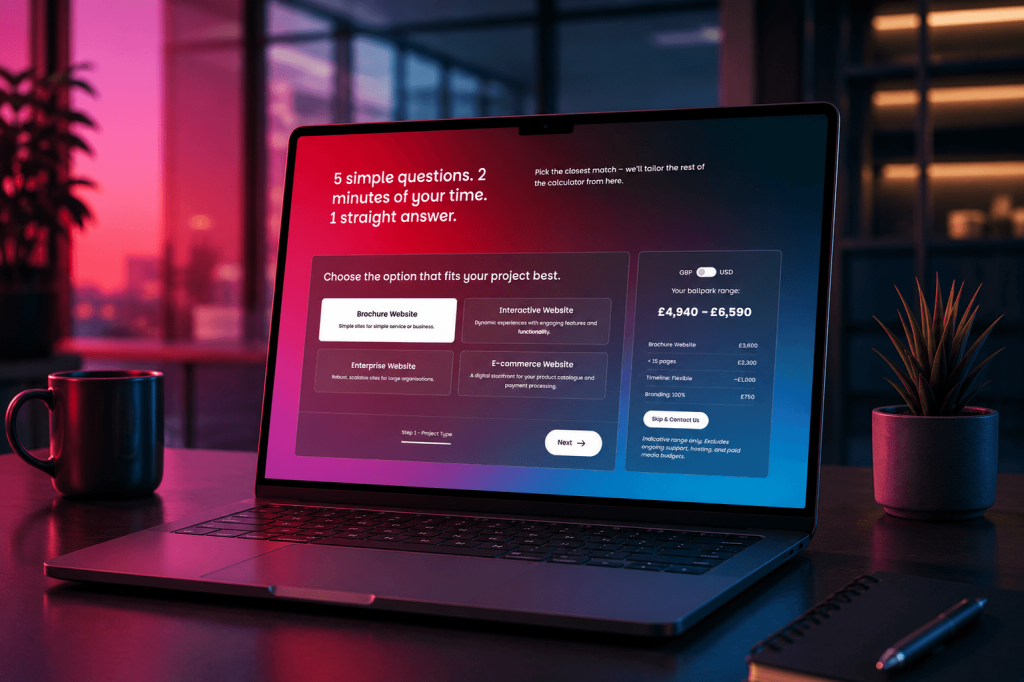
That’s what the website cost calculator is for. It’s not a quote and we don’t pretend it is. It’s an estimator: you tell it what you’re trying to do, it gives you a realistic budget bracket and, unlike a typical website calculator, a mini brief you can take into your next planning conversation. No email address required. We’re not going to hold basic numbers hostage in exchange for your contact details, because frankly, we’d find that annoying too.
If the number works for you, great, come and talk to us. If it doesn’t, you’ve lost two minutes and gained a clearer picture of the market. Either way, you’re better informed than you were.
The obvious question: why not just use a website builder?
If you’re going to be transparent about cost, you have to be willing to answer the awkward follow-up: why does an agency-built website cost more than a Wix subscription or AI credits?
So let’s give the builders their due first. Wix, Squarespace and the rest are genuinely good at what they were built for. If you’re a one-person business, a local trade, a side project – you can have a clean, functional site live by the weekend for the price of a few coffees a month. Their SEO tooling has improved a lot in recent years too: sitemaps, meta fields, alt text, SSL etc. The basics are covered, and covered well. For a huge slice of the internet, that’s exactly the right tool, and anyone who tells you otherwise is selling something.
But “the basics are covered” has a ceiling, and it arrives faster than most growing businesses expect.
You don’t control the technical layer
With a builder, you can’t meaningfully optimise server response times, control how your code is structured, implement custom structured data beyond the presets, or fix the underlying performance issues baked into the platform. If your site is slow, you’re waiting for the platform to make it faster. In a world where page speed and Core Web Vitals feed directly into how you rank – and increasingly, how you show up in AI-driven search – that’s a real constraint.
You’re competing with one hand tied
For low-competition searches, a builder site can rank fine. But if organic search actually drives revenue in your category, you’re up against competitors with custom-built sites who can control heading hierarchy, schema, internal linking architecture and load performance at a granular level. Adequate SEO versus engineered SEO is not a fair fight over time.
You don’t own it
This is the one people underestimate. A builder site lives on someone else’s platform, on their terms, at their pricing, within their template logic. You can’t take it with you. When you outgrow it – and growing businesses do – you’re not upgrading, you’re starting all over again.
A custom build is an asset
The IP is yours, the codebase is yours, and it appreciates as you invest in it rather than resetting to zero every time your needs change.
Every template hits a wall
It’s usually a small thing: you need a user journey the template doesn’t support, an integration that doesn’t exist, a layout that stubbornly refuses to look how you picture it in your head. That wall is the moment the “cheap” option starts costing you in workarounds, in compromises, and the version of your brand you settled for.
None of this means builders are bad. It means they’re built for the masses, and at a certain point your business stops being the masses.
What you’re actually paying for (it’s not the website)
We’d tell you this even if it cost us the sale: if all you want is pages on the internet, don’t hire an agency. The reason to work with one is everything that happens around the build.
A proper website project forces a kind of internal audit that most businesses never make time for. Before anyone touches a design tool, you’re answering hard questions.
- Who is this actually for?
- What do we want them to do?
- Which of our products earn their place on the homepage, and which have we just been carrying out of habit?
- Why do prospects drop off where they drop off?
- What does the sales team wish the website did for them?
That process – putting your whole proposition under the lens of creative marketing and sales – is regularly where the real value sits. We’ve had clients tell us the discovery phase sharpened their offering more than the site itself did. The website is the output; the thinking is the product.
And because our CMS is custom-built, the site can then do exactly what that thinking demands. Not “the closest template equivalent”, but exactly.
Think user flows designed around how your buyers actually make decisions, a structure that flexes when you refresh your brand or refine your offering, ongoing SEO support that compounds, because we can actually get under the bonnet of the code we wrote.
This is also why we tend to work as an extension of in-house teams rather than a supplier at arm’s length. The last thing marketing leaders need is another vendor to manage. They need capacity, craft and a partner who understands the commercial pressure they’re under– including the pressure of the budget conversation this whole article started with.
Transparency shouldn’t be a strategy, but here we are.
We’ll hold our hands up: a few years ago, we wouldn’t have been comfortable putting a cost calculator on our website. It felt like something agencies just didn’t do. But “agencies just don’t do it” is no longer a valid reason, and if a two-minute tool genuinely makes your job easier, whether or not you ever work with us, we struggle to find the argument against it.
So the website cost calculator is there. Use it to sense-check a number you’ve already got. Use it to build the case internally. Use it to work out that a builder is actually the right call for you this year – that’s a perfectly good outcome, and we’d rather you reach it with real numbers than a hunch.
And when you’re ready for the version of your website that you own outright, that ranks like it means it, and that makes your whole business sharper in the process, you’ll know roughly what it costs before we’ve even spoken. Which, as far as we’re concerned, is exactly how it should be.

Our thinking.